

Chapter One
The Fascinating Story of Bee Propolis
If you have searched “What is bee propolis?”, you may already have encountered websites making dramatic promises or describing it as a modern health discovery. The real story is far more fascinating.
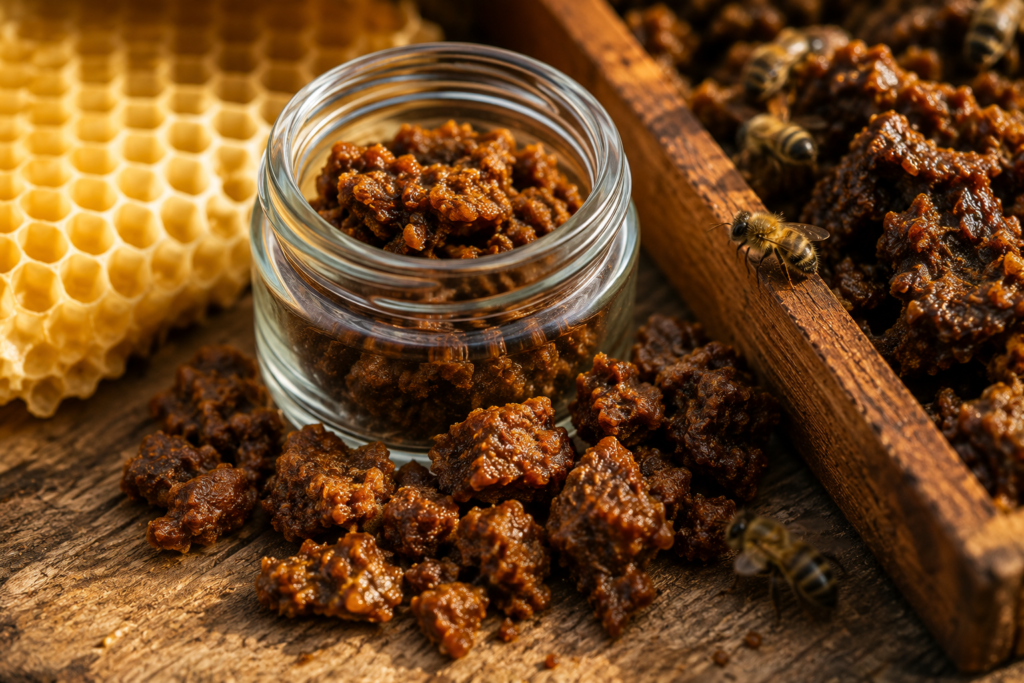
Bee propolis is a sticky, resinous material created by honey bees from natural plant resins, beeswax and other hive substances. It is not simply another bee product placed on a shop shelf. It is an essential material used by bees to protect, strengthen and maintain the living environment of their colony.
Long before humans understood microorganisms, chemistry or hygiene, honey bees were gathering protective resins from the natural world and using them throughout their hives. Every healthy colony depends upon a carefully controlled internal environment for raising young bees, storing food and surviving changing weather conditions. Propolis plays an important role in creating and maintaining that environment.
 Did You Know?
Researchers have identified hundreds of naturally occurring compounds across different types of propolis. Its exact composition changes according to the trees, plants, season, climate and landscape surrounding each colony, meaning no two natural propolis harvests are exactly alike.
Worker bees collect sticky resin from tree buds, bark and other plant surfaces. They transport this material back to the colony, where it is blended and worked into the substance we recognise as propolis.
Inside the hive, bees use propolis to seal narrow cracks, reinforce weak areas, smooth rough surfaces and reduce unwanted openings. They may also spread a fine resinous coating over internal surfaces, forming what researchers often call a propolis envelope.
Propolis is therefore not an accidental by-product of beekeeping. It is part of the colony’s sophisticated system of construction, organisation and environmental protection.
What Exactly Is Bee Propolis?
Propolis begins as resin produced by plants. Trees and shrubs naturally release resin to protect vulnerable buds, damaged bark and developing plant tissue. Honey bees recognise the usefulness of these sticky botanical substances and collect them using their mandibles.
The bees manipulate the resin, carry it on their hind legs and bring it back to the hive. There it may be combined with beeswax, pollen traces and natural bee secretions before being used throughout the colony.
Depending on its botanical source, raw propolis can appear golden brown, reddish brown, deep green or almost black. Its aroma may be woody, spicy, floral, balsamic or strongly resinous.
This natural variation is one of the qualities that makes genuine propolis so interesting. Propolis gathered by bees on Valentia Island in County Kerry may differ considerably from propolis collected in Brazil, Greece, Eastern Europe or New Zealand because the surrounding vegetation is completely different.
Why Do Honey Bees Value Propolis?
A strong honey bee colony may contain tens of thousands of individual bees living together inside a warm and densely populated space. The colony must continually regulate temperature, humidity, airflow, cleanliness and structural stability.
Bees use propolis wherever they identify a small gap, unwanted draught, rough surface or weakness. It functions as a flexible natural sealant and can help transform an irregular hollow tree or wooden hive into a more controlled living space.
If a small intruder enters the hive and is too large for the bees to remove, the colony may completely coat it in propolis. This behaviour prevents the object from remaining exposed within the hive and demonstrates just how important propolis is to the bees’ management of their environment.
To humans, propolis may appear to be a sticky brown residue. To honey bees, it is a valuable construction and protective material used with extraordinary precision.
Bee Propolis Through History
Human fascination with propolis stretches back thousands of years. Ancient cultures observed how bees used this unusual resin inside their colonies and gradually incorporated bee products into preservation practices and traditional preparations.
Ancient Egypt
Resinous substances and bee products were valued for preservation. Propolis is often associated with the materials used during ancient embalming traditions.
Ancient Greece
Greek writers recorded knowledge of bee products, and the word “propolis” itself comes from the Greek language.
The Roman World
Roman naturalists documented beekeeping and the value of hive products, helping preserve knowledge that continued through later European traditions.
Although historical claims are sometimes exaggerated in modern advertising, there is no doubt that propolis has attracted human attention for a very long time. Its unusual smell, sticky texture and obvious importance to bees made it stand apart from honey, pollen and beeswax.
Today, propolis is studied by universities and research institutions around the world. Scientists analyse its botanical origin, chemical profile, antioxidant activity and interactions with microorganisms. Results vary considerably because propolis from one region may be chemically different from propolis gathered elsewhere.
Where Does the Word “Propolis” Come From?
Pro
In front of or before
Polis
City or community
Together, the name is commonly interpreted as “defender of the city” or “before the city”—an appropriate description for a substance bees often place around hive entrances and use to protect their colony.
Why Is Bee Propolis So Special?
Honey, pollen and royal jelly are closely connected with feeding the colony. Beeswax is used to construct comb. Propolis has a different role: it helps bees shape, seal and protect the environment in which the entire colony lives.
Its composition is influenced by local biodiversity, making propolis a chemical reflection of the landscape surrounding the hive. Each harvest can carry the signature of nearby trees, hedgerows, shrubs and wild plants.
This natural complexity is also why propolis quality can be difficult to judge. The quality of the raw material, the cleanliness of the harvest, the extraction process and the concentration of the finished product all matter.
Propolis is not remarkable because of a single ingredient. It is remarkable because honey bees gather a complex mixture of plant resins and transform them into a practical material that supports the life of the entire colony.
In the next chapter, we will follow the journey from tree bud to beehive and examine exactly how worker bees collect, transport and use propolis inside the colony.
Coming Next
How Honey Bees Collect and Make Propolis
 Curious to Try Premium Irish Propolis?
Explore our high-potency Irish Propolis Tincture, carefully produced by experienced beekeepers on Valentia Island.
Chapter Two
How Honey Bees Collect and Make Propolis
Every drop of bee propolis begins its journey far away from the hive. Unlike honey, which starts as flower nectar, propolis begins as sticky resin produced naturally by trees and shrubs. These resins are the plants’ own defence system, protecting fresh buds and damaged bark against insects, fungi and harsh weather.
Honey bees have evolved to recognise these valuable resins. During warm weather, experienced worker bees leave the colony in search of suitable sources, often flying hundreds of metres from the hive before locating resin-producing trees.
Did You Know?
Unlike nectar foragers, only certain worker bees collect propolis. It is a specialised task requiring strength and patience because resin is extremely sticky and much harder to gather than nectar or pollen.
Where Does Propolis Come From?
The exact source of propolis depends entirely on where the colony lives. Around the world, bees gather resin from many different trees and plants, creating unique propolis with its own colour, aroma and chemical profile.
 Poplar
One of the best-known sources of European propolis. Its sticky buds provide bees with abundant resin during spring.
 Birch
Birch
Birch buds produce aromatic resins that contribute to the unique composition of some propolis harvests.
 Willow
Willows growing beside rivers and wetlands can also provide useful resin for honey bees.
On Valentia Island, bees forage across hedgerows, native trees, gardens and the surrounding countryside. Every season offers a slightly different mix of resin sources, making each year’s propolis unique.
Collecting Sticky Resin Is Hard Work
Unlike nectar, resin cannot simply be sucked into the bee’s honey stomach. Worker bees must bite, scrape and pull sticky resin away from tree buds using their powerful mandibles.
This can take several minutes on a single bud. Once enough resin has been gathered, the bee carefully transfers it to her pollen baskets (known as corbiculae) on her hind legs.
The finished resin load is surprisingly heavy compared to the size of the bee. Flying home requires considerably more effort than carrying nectar, making propolis collection one of the colony’s most demanding jobs.
From Tree Bud to Beehive
Tree Resin → Worker Bee →  Pollen Baskets →
  Beehive → Bee Propolis
Every tiny piece of propolis begins as a natural plant resin before being transformed by the remarkable work of thousands of honey bees.
Once the foraging bee finally returns home, her work isn’t over. The resin must still be removed, processed and distributed throughout the colony before it becomes the finished material we know as bee propolis.
In the next part of this chapter, we’ll step inside the hive to discover how house bees transform sticky resin into one of nature’s most remarkable building materials—and why the entire colony depends upon it.
Chapter Two • Part Two
Inside the Hive – How Bees Turn Resin into Propolis
After an exhausting journey collecting sticky tree resin, the foraging bee finally returns home. Unlike nectar, she cannot simply unload her cargo herself. Instead, she waits patiently while younger house bees carefully remove the resin from her pollen baskets.
This can take several minutes because raw resin is incredibly sticky. Bees work together, pulling and stretching the resin with their mandibles before mixing it with tiny amounts of beeswax and their own natural enzymes. This teamwork transforms raw tree resin into the remarkable material known as bee propolis.
Amazing Bee Fact
A bee returning with resin often cannot remove it by herself. Other worker bees must help unload the sticky material before she can return to forage again.
Building the Propolis Envelope
Once processed, bees spread propolis around the hive wherever it is needed. They seal tiny cracks that would otherwise create unwanted draughts, strengthen weak joints within the hive and smooth rough internal surfaces.
Researchers often describe this thin coating as the Propolis Envelope. Rather than being applied in one thick layer, bees gradually spread an almost invisible coating across many internal surfaces throughout the hive.
Although people often think of honey as the hive’s greatest treasure, experienced beekeepers know that propolis quietly performs many of the essential maintenance jobs that help keep a colony functioning efficiently.
How Bees Use Propolis
Seal Gaps
Closing tiny openings that could create unwanted airflow.

Strengthen the Hive
Adding stability to joints, corners and weak areas.
Maintain the Colony
Helping create the carefully controlled environment bees depend upon.
One of Nature’s Greatest Team Efforts
A single honey bee cannot produce meaningful quantities of propolis alone. Every successful harvest depends upon thousands of worker bees carrying out different jobs within the colony.
Some bees locate suitable trees. Others collect resin. House bees unload the sticky material before additional workers distribute it throughout the hive. This extraordinary cooperation allows a colony to continually maintain and improve its home.
When beekeepers inspect a healthy hive, they often notice just how much propolis has accumulated around frames, joints and hive entrances. While it can make inspections considerably more difficult—sometimes gluing hive parts firmly together—it also demonstrates that the bees are actively maintaining their home.
Why Beekeepers Love (and Sometimes Curse) Propolis
Ask almost any experienced beekeeper about propolis and you’ll probably receive a smile.
Propolis can glue hive boxes together so tightly that opening a hive sometimes requires a hive tool and plenty of patience. Frames become firmly attached, lids refuse to lift and gloves quickly become sticky.
Despite the inconvenience, most beekeepers secretly appreciate seeing plenty of propolis. It is often a sign that the colony is healthy, active and behaving naturally.
How Beekeepers Harvest Propolis
Modern beekeepers usually harvest propolis using specially designed flexible collection mats. These mats contain narrow slots that encourage bees to fill the gaps with fresh propolis.
Once enough propolis has been collected, the mat is removed and frozen. Because propolis becomes brittle when cold, it can then be gently flexed, allowing the clean resin to break away before being carefully cleaned and prepared for processing.
This harvesting method allows beekeepers to collect high-quality raw propolis while causing minimal disturbance to the colony.
From Tree Resin to Premium Propolis
Every bottle of genuine propolis tincture begins with countless journeys made by thousands of worker bees collecting tiny quantities of sticky tree resin. What appears to be a simple bottle on a shelf actually represents an extraordinary amount of work by one of nature’s most organised societies.
Understanding how bees collect and produce propolis makes it easier to appreciate why high-quality propolis is so valuable. It cannot be manufactured in a factory. Every drop begins with healthy bees, healthy landscapes and countless hours of work inside the hive.
In the next chapter we’ll explore what makes up bee propolis, examining the fascinating natural compounds found within it, why no two batches are identical and why scientists continue to study this remarkable bee product today.
Chapter Two • Part Three
Why Every Batch of Propolis Is Different
One of the most fascinating things about bee propolis is that no two harvests are ever exactly the same. Unlike manufactured products, which are produced to identical specifications, propolis reflects the landscape surrounding every hive.
Every tree, shrub and flowering plant contributes its own unique chemistry to the resin collected by honey bees. As the seasons change, so too does the availability of these natural resins, meaning the colour, aroma and composition of propolis naturally evolve throughout the year.
 Nature Creates Every Batch
Unlike synthetic supplements manufactured from laboratory ingredients, genuine propolis begins with thousands of tiny decisions made by honey bees as they choose which trees and plants to visit each day.
What Influences Propolis Quality?
Tree Species
Different trees produce different resins, giving every region its own characteristic propolis.
 Season
Spring, summer and autumn all provide different resin sources, changing the composition naturally.
🌦 Climate
Weather conditions influence which plants produce resin and how actively bees collect it.
The Bees
Some strains of honey bee naturally collect far greater quantities of propolis than others.
This natural variation is one reason why experienced beekeepers never judge propolis by colour alone. A lighter propolis is not necessarily inferior to a darker one, and a stronger smell does not automatically indicate higher quality. What matters most is the quality of the raw material, careful harvesting and proper preparation.
Why Biodiversity Matters
Healthy bees thrive in healthy landscapes. Areas rich in native trees, flowering hedgerows and diverse plant life provide bees with a wider range of natural resins throughout the year.
At Valentia Bee Beds, our colonies forage across one of Ireland’s most beautiful coastal environments. Surrounded by native vegetation, Atlantic hedgerows and diverse seasonal flora, the bees have access to a rich variety of natural resin sources.
A Beekeeper’s Perspective
As beekeepers, we don’t simply see propolis as another product to harvest. Every scrape of resin tells a story about where our bees have been foraging, the season they’ve experienced and the incredible work taking place inside the hive every single day.
Why We Believe Quality Always Comes First
Today’s market offers countless propolis products, but they are not all produced to the same standard. Some contain only a small amount of genuine propolis alongside numerous additional ingredients, making it difficult for consumers to know exactly what they are buying.
Our philosophy is straightforward: focus on producing a carefully prepared, high-quality Irish Propolis Tincture using genuine propolis rather than relying on unnecessary fillers or marketing buzzwords.
By working directly with our own bees, we know exactly where our propolis comes from and the care taken at every stage—from collection and cleaning through to extraction and bottling.
The Journey Has Only Just Begun…
We’ve followed propolis from tree buds to the hive, watched bees transform sticky resin into one of nature’s most remarkable materials and discovered why every batch is unique.
But what actually makes propolis so chemically complex?
Why have scientists identified hundreds of naturally occurring compounds within it, and why does it continue to attract worldwide research?
In the next chapter we’ll explore the fascinating chemistry of bee propolis, examining the natural compounds that make this extraordinary bee product unlike almost anything else found in nature.
Continue Exploring Bee Propolis
Every chapter reveals another piece of the remarkable story behind one of the honey bee’s greatest creations.
Chapter Two • Part Four
Why Some Honey Bees Collect More Propolis Than Others
One of the questions beekeepers are often asked is why some hives seem to produce huge quantities of propolis while others produce very little. The answer is surprisingly complex and involves a combination of genetics, local vegetation, climate and the natural behaviour of the bees themselves.
Just as some colonies are naturally better honey producers or gentler to handle, some strains of honey bees have a much stronger instinct to collect plant resins. These colonies often build up impressive quantities of propolis throughout the hive, coating frames, sealing joints and narrowing even the smallest gaps.
Did You Know?
Beekeepers sometimes joke that they can tell which colonies collect the most propolis because they need considerably more effort to open. Hive boxes, frames and even gloves may become firmly glued together with sticky resin.
Different Bee Races Behave Differently
Around the world there are several recognised races and strains of the Western Honey Bee (Apis mellifera). Each has evolved under different environmental conditions and displays slightly different behaviours.
For example, Caucasian honey bees (Apis mellifera caucasia) are famous among beekeepers for collecting exceptionally large amounts of propolis. While this can make hive inspections more challenging, it also demonstrates just how strongly genetics influence propolis gathering behaviour.
Other European strains, including those commonly kept in Ireland, generally collect more moderate quantities. However, even neighbouring colonies headed by different queens can vary dramatically in the amount of propolis they produce.
 Queen Genetics
The queen passes behavioural traits to her offspring, including the colony’s natural tendency to gather propolis.
Local Trees
Without nearby resin-producing trees and shrubs, even the best propolis-collecting colony cannot gather large quantities.
☀ Climate
Warm weather softens plant resins, making them easier for bees to collect than during colder conditions.
Can Beekeepers Encourage More Propolis?
Interestingly, the answer is yes.
Many professional beekeepers who harvest propolis use specially designed propolis collection mats. These flexible plastic grids contain narrow openings that encourage bees to seal them with fresh propolis. Once the bees have filled the gaps, the mats are removed, frozen and gently flexed, allowing the propolis to separate cleanly.
Some beekeepers may also increase ventilation slightly or create small gaps within the hive. Bees instinctively respond by attempting to seal these openings with more propolis. This behaviour highlights just how determined honey bees are to maintain a carefully controlled living environment.
A Perfect Example of Bee Intelligence
Honey bees don’t collect propolis because they have been taught to do so. They collect it because millions of years of evolution have programmed them to recognise the value of protecting their home using natural plant resins.
Our Experience at Valentia Bee Beds
Working with bees every day gives us a fascinating insight into these natural differences. Some colonies are noticeably enthusiastic propolis collectors, while others are much lighter users of resin despite sharing the same landscape.
Opening one hive might reveal only a light coating of propolis around the frames. The next colony may require considerably more effort to inspect because every joint, corner and frame has been carefully sealed by thousands of diligent worker bees.
These differences are part of what makes beekeeping so endlessly fascinating. No two colonies behave exactly alike, and no two seasons produce identical propolis.
Beekeeper’s Note
One of the first things visitors notice during our Bee Beds Experience is the distinctive aroma surrounding an active hive. That rich resinous scent comes partly from fresh propolis. It changes throughout the season and is one of the reasons every visit to the Bee Beds feels slightly different.
As we’ve now discovered, producing propolis is far from a simple process. It depends on healthy honey bees, suitable trees, favourable weather, remarkable teamwork and an extraordinary instinct that has evolved over millions of years.
In the next chapter we’ll look even deeper, exploring the fascinating natural chemistry of propolis and why scientists continue to study one of the most complex substances ever produced by honey bees.
Premium Irish Bee Products
Experience Premium Irish Propolis
Now that you’ve discovered how honey bees collect propolis, why it is so important to the colony and what makes a truly high-quality propolis tincture, you can appreciate why not all products are the same.
At Valentia Bee Beds, we don’t simply buy propolis from anonymous suppliers. We work with our own honey bee colonies on Valentia Island, along Ireland’s spectacular Wild Atlantic Way, where healthy bees gather natural plant resins throughout the season.
Our philosophy is simple — produce a carefully prepared high-potency Irish Propolis Tincture using quality raw propolis, rather than relying on unnecessary fillers or complicated ingredient blends. We believe customers deserve complete transparency about where their propolis comes from and how it is produced.
Whether you’re interested in propolis because of your passion for beekeeping, your curiosity about one of nature’s most remarkable bee products, or you’re searching for a premium Irish propolis tincture, we’d be delighted to share our carefully crafted product with you.
Discover Our Premium Irish Propolis
Small batches • High potency • Produced by experienced Irish beekeepers on Valentia Island
Chapter Four
The History of Bee Propolis
From Ancient Egypt to Modern Ireland
Estimated Reading Time • 8 Minutes
“Long before laboratories, microscopes and scientific journals, honey bees had already perfected one of nature’s most extraordinary substances.”
Thousands of years before modern science began investigating bee propolis, ancient civilisations had already recognised that honey bees were producing something remarkable. Across continents and throughout history, people have admired, collected and studied this fascinating resin created entirely by bees.
The story of bee propolis is also the story of humanity’s relationship with honey bees. From prehistoric honey hunters climbing cliffs in search of wild colonies to modern researchers studying the natural chemistry of propolis, our fascination with this remarkable bee product has never disappeared.
Unlike many natural substances that have come and gone throughout history, propolis has remained part of human culture for thousands of years. Different civilisations valued it for different reasons, but one thing united them all — they recognised that honey bees possessed knowledge that humans could only begin to understand.
The Journey Through Time
8000 BC
Prehistoric Honey Hunters

3000 BC
Ancient Egypt Discovers the Value of Bee Products

400 BC
Ancient Greece Gives Propolis Its Name
100 AD
The Roman Empire Expands Beekeeping Knowledge

Middle Ages
Monasteries Preserve the Art of Beekeeping

1800–1900s
Scientists Begin Studying Propolis
Today
Worldwide Research & Modern Irish Beekeeping
Did You Know?
Honey bees have existed for around 120 million years, while modern humans have existed for only around 300,000 years. Long before humans built cities or wrote books, bees had already perfected the remarkable art of collecting and using propolis.
As we travel through history in this chapter, you’ll discover how different cultures viewed bee propolis, why ancient civilisations valued bee products so highly and how our understanding of propolis has gradually evolved into the scientific research taking place today.
Our journey begins over five thousand years ago, on the banks of the River Nile, where one of history’s greatest civilisations first recognised the extraordinary value of honey bees.
Next Stop…
Ancient Egypt
The civilisation that placed bees among the symbols of kings.
Chapter Four • Part Two
Ancient Egypt – A Civilisation Built Alongside Bees
More than five thousand years ago, while much of the world was still developing early settlements, the Ancient Egyptians had already become highly skilled beekeepers. Along the fertile banks of the River Nile, honey bees were not simply useful insects—they were deeply respected and woven into everyday Egyptian life.
The annual flooding of the Nile created one of the richest agricultural landscapes in the ancient world. Fields burst into flower throughout the growing season, providing an ideal environment for honey bees to thrive. As a result, honey, beeswax and other bee products became valuable resources within Egyptian society.
 Historical Insight
Some of the earliest known illustrations of organised beekeeping have been discovered in Ancient Egyptian temples, showing workers tending hives, collecting honey and storing it in clay vessels.
The Honey Bee – A Symbol of Royal Power
To the Egyptians, bees represented much more than honey production. The honey bee became an important royal emblem associated with Lower Egypt and appeared in the official titles of many Pharaohs for thousands of years.
This extraordinary relationship demonstrates the respect the Egyptians had for honey bees. Few insects have ever held such an important place within the political and religious symbolism of an entire civilisation.
Royal Symbol
The honey bee appeared in royal titles and became one of Ancient Egypt’s most recognisable symbols of authority.
Valuable Honey
Honey was considered a luxury product, treasured as both a food and an offering within Egyptian society.
🕯 Beeswax
Beeswax was widely used for practical purposes, including candles, sealing containers and artistic work.
Did the Egyptians Use Propolis?
Ancient texts and archaeological evidence show that the Egyptians made extensive use of bee products. Honey and beeswax are particularly well documented, while propolis has long been associated with the materials available to Egyptian embalmers and preservation practices.
Modern historians continue to study exactly how propolis was used in Ancient Egypt. While some popular claims go beyond the available evidence, there is little doubt that Egyptian beekeepers understood the value of the remarkable substances produced by honey bees.
More Than Just Honey
To the Ancient Egyptians, a hive was far more than a source of sweet honey. It provided wax, valuable natural materials and a symbol of order, productivity and prosperity—qualities they admired within their own civilisation.
The Beginning of Humanity’s Fascination
The Egyptians may never have understood the complex chemistry of bee propolis in the way modern scientists do today, but they recognised something important: honey bees created remarkable natural substances unlike anything else found in nature.
That curiosity would not disappear with the fall of Ancient Egypt. It travelled across the Mediterranean, where another great civilisation—the Ancient Greeks—would observe bees closely, study their behaviour and ultimately give propolis the name by which it is still known throughout the world today.
Next Destination…
Ancient Greece
The civilisation that gave bee propolis its name and inspired generations of natural philosophers.
Chapter Four • Part Three
Ancient Greece & The Roman Empire
As the influence of Ancient Egypt faded, the fascination with honey bees spread across the Mediterranean. The Greeks became careful observers of nature, studying the behaviour of animals, plants and insects with a curiosity that helped shape the foundations of modern science.
Among the creatures that captured their imagination were honey bees. Their remarkable organisation, teamwork and productivity seemed almost impossible to explain, leading philosophers and natural historians to spend countless hours observing life inside the hive.
 The Birth of the Word “Propolis”
The name Propolis comes from two Ancient Greek words:
Pro = Before / In Defence Of
Polis = City
Together, the name is commonly interpreted as “Defender of the City.” It perfectly describes the way honey bees use propolis to protect and maintain their colony.
Aristotle and the Study of Honey Bees
One of the greatest thinkers of Ancient Greece was Aristotle, often regarded as one of history’s first great natural scientists. More than 2,300 years ago, Aristotle carefully documented many aspects of honey bee behaviour, making his observations among the earliest detailed records of beekeeping ever written.
Although some of his conclusions were later proven incorrect—as scientific knowledge advanced—his work demonstrated something remarkable: humans had begun studying bees not simply because they produced honey, but because their society was so incredibly complex.
Aristotle described the organisation of colonies, the construction of honeycomb and the different roles performed by worker bees. His observations laid important foundations for future generations of natural historians.
A Remarkable Achievement
Imagine studying honey bees over two thousand years ago—without microscopes, cameras or protective bee suits. Everything early naturalists learned came through patience, observation and curiosity.
The Roman Empire Continues the Story
As the Roman Empire expanded across Europe, so too did knowledge of agriculture and beekeeping. Roman writers documented many aspects of hive management, recognising the economic and practical importance of honey bees.
Among the best-known Roman authors was Pliny the Elder, whose encyclopaedic work Natural History recorded observations on plants, animals and bee products. Although modern science has greatly expanded our understanding since his time, these writings helped preserve valuable knowledge that might otherwise have been lost.
🏛 Roman Agriculture
Successful farming relied heavily on healthy honey bee populations for pollination and honey production.
 Written Records
Roman scholars carefully documented bee behaviour, helping preserve knowledge for future generations.
Growing Knowledge
Beekeeping gradually spread throughout Europe as Roman influence expanded across the continent.
More Than Two Thousand Years Later
Modern beekeepers may use removable-frame hives, protective clothing and sophisticated scientific equipment, but in many ways they are still fascinated by the very same questions that intrigued the Greeks and Romans centuries ago.
How do honey bees organise themselves so efficiently? Why do they collect propolis? How do they communicate? And how can such a tiny insect create materials that continue to fascinate scientists around the world?
Knowledge Passed Through Generations
Without the observations recorded by early civilisations, much of what we know about historical beekeeping could have been lost. Their curiosity created a bridge between ancient wisdom and modern scientific discovery.
Following the fall of the Roman Empire, Europe entered a new era. While kingdoms rose and fell, one tradition quietly survived in monasteries, villages and rural communities—the timeless practice of keeping honey bees.
Next Stop…
The Middle Ages
How monks, farmers and village beekeepers preserved the ancient art of beekeeping for future generations.
Chapter Four • Part Four
The Middle Ages to Modern Science
When the Roman Empire declined, much of Europe’s scientific knowledge was fragmented. Yet throughout these changing centuries, one tradition quietly endured — the keeping of honey bees. While kingdoms rose and fell, bees continued their work exactly as they had for millions of years.
Across Europe, monasteries, farms and rural communities became the guardians of beekeeping knowledge. Honey remained an important food, beeswax became increasingly valuable and the careful management of bee colonies continued to be passed from one generation to the next.
 Did You Know?
During the Middle Ages, beeswax was one of Europe’s most valuable natural products. It was used to make high-quality candles that burned brighter and cleaner than those made from animal fat, making it especially prized by churches and monasteries.
Monasteries – Protecting the Art of Beekeeping
Throughout medieval Europe, monasteries played an important role in preserving practical knowledge, including agriculture, gardening and beekeeping. Monks often maintained carefully managed apiaries, producing honey and beeswax for everyday use and religious ceremonies.
Although modern hive designs had not yet been invented, generations of beekeepers developed an impressive understanding of seasonal bee behaviour through observation and experience. This practical knowledge would eventually form the foundations of modern beekeeping.
 Monasteries
Many religious communities became skilled beekeepers, helping preserve knowledge during uncertain times.
Honey
Before refined sugar became widely available, honey was one of the most important natural sweeteners in Europe.
🕯 Beeswax
Pure beeswax candles were considered superior and became highly sought after throughout medieval Europe.
The Birth of Modern Beekeeping
The nineteenth century transformed beekeeping forever. One of the most significant developments came with the invention of the movable-frame hive, allowing beekeepers to inspect colonies far more effectively without destroying the comb.
This innovation opened the door to a much deeper understanding of honey bee biology. Beekeepers could now study brood development, queen behaviour, honey storage and propolis use in ways that had never before been possible.
 Observation Changed Everything
For the first time in history, beekeepers could regularly observe the inner workings of a healthy colony without causing major disruption. This marked the beginning of modern beekeeping and eventually paved the way for scientific research into bee behaviour and propolis.
From Curiosity to Scientific Research
During the twentieth century, scientists began analysing propolis using increasingly sophisticated laboratory techniques. Rather than relying solely on observation, researchers were able to investigate its chemical composition in remarkable detail.
Over time, hundreds of naturally occurring compounds were identified, revealing just how chemically complex propolis really is. Researchers also discovered that its composition varies naturally depending on geography, local vegetation, climate and the tree species available to honey bees.
Today, universities and research institutions across the world continue studying bee propolis. While much has already been learned, scientists believe there is still far more to discover about this extraordinary natural material.
A Global Interest
Research into bee propolis now takes place across Europe, Asia, North and South America, Australia and many other regions. Each country contributes to a growing understanding of one of nature’s most fascinating bee products, while recognising that local propolis differs according to the plants available to honey bees.
A Story That Continues Today
From prehistoric honey hunters to Egyptian beekeepers, Greek philosophers, Roman scholars, medieval monks and modern scientists, the story of propolis has continued uninterrupted for thousands of years.
Yet perhaps the most remarkable part of the story is this: despite all our advances in science and technology, honey bees continue producing propolis exactly as they always have. Every day, in hives across the world, worker bees still gather sticky tree resins and transform them into one of nature’s most extraordinary substances.
More Than 5,000 Years of History… And Still Being Written
Although our understanding of bee propolis has grown enormously, the bees themselves have never changed their remarkable behaviour. The same natural instincts that fascinated ancient civilisations continue inside every healthy hive today.
In the final part of this chapter, we’ll return to the present day, exploring the tradition of Irish beekeeping, the unique environment of the Wild Atlantic Way and how our own journey with honey bees on Valentia Island became part of this remarkable history.
Final Stop…
 Modern Ireland & Valentia Island
Where an ancient story continues with every new generation of honey bees.
Chapter Four • Part Five
Modern Ireland – An Ancient Story Continues
“More than five thousand years after the first great civilisations admired honey bees, their remarkable story continues every day on the rugged Atlantic coastline of Ireland.”
Although our understanding of honey bees has grown enormously over the centuries, the bees themselves have remained wonderfully unchanged. Every spring they leave the hive in search of nectar, pollen and sticky plant resins, gathering the very same natural materials that fascinated the Egyptians, inspired the Greeks and were carefully observed by Roman scholars.
Today, across Ireland, thousands of passionate beekeepers continue this ancient tradition. Every hive inspection, every honey harvest and every piece of carefully collected propolis forms another small chapter in a story that stretches back through human history.
 Irish Beekeeping Today
Ireland’s mild climate, diverse hedgerows, native trees and long flowering season create an excellent environment for honey bees. Although Irish beekeeping has modernised dramatically, the relationship between beekeeper and colony remains much the same as it always has — built on patience, observation and respect for nature.
Valentia Island – Where Nature Still Leads
On Ireland’s spectacular Wild Atlantic Way, Valentia Island offers a landscape shaped by powerful Atlantic winds, clean sea air and an abundance of native vegetation. It is here that our own honey bee colonies forage across hedgerows, gardens, wildflowers and native trees, collecting the natural plant resins that eventually become propolis.
Every season brings subtle differences. Some years produce wonderfully aromatic propolis with rich resinous notes, while other seasons create lighter colours or slightly different aromas depending on the weather and the plants available to the bees. That natural variation is part of what makes genuine propolis so fascinating.
Every Hive Tells Its Own Story
When we open one of our hives, we’re not simply inspecting bees. We’re witnessing millions of years of evolution and thousands of years of shared human history continuing exactly as nature intended.
Why We Never Stop Learning
One of the greatest lessons beekeeping teaches is humility. No matter how much we learn, honey bees continue to surprise us. Every colony behaves a little differently. Every season presents new challenges. Every harvest tells its own unique story.
This endless opportunity to learn is one of the reasons beekeeping has fascinated humanity for thousands of years. From the first honey hunters climbing cliffs in search of wild colonies to modern researchers using advanced laboratory equipment, our curiosity has never faded.
The Story Continues…
Every visitor who steps inside our Bee Beds, every new beekeeper who discovers the remarkable world of honey bees and every person who learns about propolis becomes part of a story that began thousands of years ago and is still unfolding today.
A Story Thousands of Years in the Making
From prehistoric honey hunters…
To the Pharaohs of Ancient Egypt…

To the philosophers of Ancient Greece…
🏛
To Roman scholars…
To medieval monasteries…
To modern scientists…
…the remarkable story of bee propolis continues every single day inside healthy honey bee colonies across the world.
“The history of propolis isn’t something that ended long ago.
It is still being written—one bee, one colony and one generation at a time.”
Chapter Five
Frequently Asked Questions About Bee Propolis
Everything You’ve Ever Wanted to Know
Whether you’re completely new to bee propolis or you’ve been using bee products for years, questions naturally arise. Below you’ll find answers to some of the most frequently asked questions we receive about bee propolis, how honey bees produce it and what makes it such a fascinating natural substance.
Section One – Understanding Bee Propolis
Let’s begin with the questions almost everyone asks when first discovering propolis.
What is Bee Propolis?
Bee propolis is a natural resinous substance produced by honey bees using sticky resins collected from tree buds, bark and other plants. Bees combine these plant resins with beeswax and natural enzymes before using the finished propolis throughout the hive.
It plays an essential role in helping bees seal small gaps, reinforce the hive and maintain the colony’s carefully controlled environment.
Is Bee Glue the Same as Propolis?
Yes. “Bee Glue” is simply the popular nickname for propolis. Beekeepers often use this term because propolis is incredibly sticky and naturally glues hive parts together.
Although the scientific name is propolis, both terms describe exactly the same remarkable substance.
Where Does Propolis Come From?
Propolis begins as sticky resin produced naturally by trees and shrubs. Honey bees collect these resins before carrying them back to the hive in their pollen baskets.
Different countries, climates and tree species produce different types of resin, meaning every region naturally creates its own unique propolis.
Why Do Honey Bees Make Propolis?
Honey bees use propolis to maintain and protect their home. They instinctively seal unwanted gaps, strengthen hive joints and coat internal surfaces with thin layers of propolis.
Without propolis, the hive would be far less protected from the outside environment.
 What Does Propolis Smell Like?
Fresh propolis has a distinctive resinous aroma that many people describe as warm, woody and slightly sweet. Depending on the plants available to the bees, some propolis may also have hints of pine, herbs or balsamic notes.
Because every batch is different, the aroma naturally varies from one location and season to another.
 Why Does Propolis Vary in Colour?
Colour depends mainly on the trees and plants visited by the bees. Propolis can range from golden brown and reddish brown to dark brown or almost black.
A darker colour does not automatically mean better quality. The source of the resin is much more important than appearance alone.
 Why Is Propolis So Sticky?
The natural plant resins collected by honey bees are designed by trees to be sticky and protective. Bees preserve many of these characteristics when transforming resin into propolis.
On warm days, fresh propolis can become extremely soft and adhesive, which is why beekeepers affectionately call it “bee glue.”
Is Every Batch of Propolis Different?
Yes. Because bees collect resin from different plants, every batch of propolis naturally reflects its local environment. Climate, tree species, geography and the time of year all influence the finished product.
This natural variation is one of the reasons genuine bee propolis is such an interesting and unique bee product.
Next Section
In Part Two we’ll answer some of the most common questions about honey bees themselves, including why some colonies collect more propolis than others, which trees produce the best resin and why beekeepers value propolis so highly.
Chapter Five • Part Two
Honey Bees & Bee Propolis
Now that we’ve explored what propolis is, let’s answer some of the most common questions about how honey bees collect it and why it plays such an important role inside every healthy hive.
Do All Honey Bees Collect Propolis?
All honey bee colonies use propolis, but not every colony collects the same amount. The quantity depends on genetics, local vegetation, weather conditions and the availability of resin-producing trees.
Some colonies produce only small amounts, while others become famous among beekeepers for coating almost every surface with sticky propolis.
Which Trees Produce the Best Propolis?
Honey bees collect resin from many different trees depending on where they live. In Europe, poplar is one of the best-known sources, while birch, willow, alder, horse chestnut and certain conifers can also contribute valuable resins.
Because every landscape is different, every region naturally produces its own unique propolis.
Why Do Some Colonies Produce More Propolis?
Genetics plays a major role. Certain strains of honey bees naturally gather much larger quantities of resin than others. Environmental conditions also influence how much propolis is collected during the season.
Experienced beekeepers quickly learn that every colony has its own personality—and its own enthusiasm for collecting propolis.
Why Do Bees Seal Every Tiny Gap?
Honey bees are remarkable architects. They instinctively seal even the smallest cracks with propolis to help regulate airflow, reduce unwanted openings and maintain the carefully controlled environment inside the hive.
To a colony, no gap is too small to repair.
Can Beekeepers Encourage Bees to Produce More Propolis?
Yes. Many beekeepers use specially designed propolis collection mats that encourage bees to fill narrow gaps with fresh propolis. Once the mats are full, they can be removed and the propolis carefully harvested.
This method allows propolis to be collected with minimal disturbance to the colony.
Why Do Beekeepers Call Propolis “Bee Glue”?
Fresh propolis is incredibly sticky. It naturally bonds hive parts together so effectively that hive boxes, lids and frames can become firmly sealed.
The nickname “bee glue” reflects both its adhesive nature and its importance as one of the hive’s natural building materials.
Do Bees Collect Propolis All Year Round?
No. Propolis collection is usually greatest during the warmer months when tree resins are softer and easier to gather. Activity naturally slows as temperatures fall and resin sources become less available.
Seasonal changes are one reason why every year’s propolis harvest can be slightly different.
 Does the Local Environment Affect Propolis?
Absolutely. The surrounding trees, hedgerows, shrubs and flowering plants all influence the resins available to honey bees. Geography, biodiversity and even seasonal weather patterns help shape the colour, aroma and composition of every batch of propolis.
This is why propolis collected in different parts of the world naturally varies and why local environments play such an important role.
Coming Up Next
In Part Three we’ll explain how to recognise a high-quality propolis product, what to look for on labels and why not all propolis tinctures are created equal.
Chapter Five • Part Three
Choosing a High-Quality Propolis Product
With so many propolis products now available, choosing the right one can feel confusing. Bottles often look similar, labels can be difficult to interpret and prices vary considerably. Understanding a few key principles can help you make a more informed choice.
Remember…
The quality of any propolis product begins long before it reaches the bottle. It starts with healthy bees, suitable forage, careful harvesting and thoughtful processing.
 Does a Darker Propolis Mean Better Quality?
Not necessarily.
The colour of propolis depends largely on the plants and trees visited by the bees. High-quality propolis may be light brown, reddish brown or much darker. Colour alone should never be used to judge quality.
Does a Stronger Smell Mean Better Propolis?
No.
Different plants naturally produce different aromas. Some excellent propolis has a powerful resinous scent, while other equally high-quality batches are much milder.
 What Is a Propolis Tincture?
A propolis tincture is a liquid extract made by soaking raw propolis in a suitable solvent, commonly food-grade alcohol. This process extracts many of the naturally occurring compounds from the raw propolis into a convenient liquid form.
Different manufacturers use different extraction methods, strengths and formulations.
 What Should I Look For on the Label?
Look for clear information about the product rather than relying on marketing claims alone.
- Country of origin.
- Clear ingredient list.
- Type of extract.
- Storage instructions.
- Manufacturer details.
- Any relevant usage guidance.
Does the Country of Origin Matter?
The environment in which bees forage influences the character of propolis. Local tree species, biodiversity and climate all contribute to its natural composition.
Many people prefer products with a clearly stated origin because it provides greater transparency about where the propolis was produced.
 Why Do Prices Vary So Much?
Producing propolis is extremely labour-intensive for honey bees, and harvesting it requires additional work from the beekeeper. Differences in sourcing, processing methods, extraction techniques and packaging can all influence the final price.
Rather than choosing solely on price, it’s worth considering the quality and transparency of the product.
Is More Ingredients Always Better?
Not always.
Some products combine propolis with numerous additional ingredients, while others focus on propolis itself. Neither approach is automatically superior—it depends on the purpose of the product and the quality of the ingredients used. Reading the ingredient list carefully helps you understand exactly what you’re buying.
 What Do We Believe Makes a Great Propolis Product?
At Valentia Bee Beds and Island Organix, we believe quality begins with responsible beekeeping and complete transparency. Healthy bees, carefully harvested propolis, thoughtful preparation and clear information about the product all matter.
Our philosophy is simple: produce a premium Irish propolis tincture using quality raw propolis and let the product speak for itself.
Next Section
In Part Four we’ll answer practical questions about storing propolis, shelf life, natural changes in appearance and how to keep your product in the best possible condition.
Chapter Five • Part Four
Storing & Caring for Your Propolis
Like many natural bee products, propolis can change slightly over time. Small differences in colour, aroma or texture are often perfectly normal and simply reflect the natural character of genuine propolis. Below are some of the most common questions people ask about storing and caring for their propolis products.
Natural Products Naturally Vary
Unlike mass-produced synthetic products, genuine bee propolis is created by honey bees. Small natural variations from one batch to another are completely expected.
 Does Propolis Expire?
Most propolis products have a best-before date provided by the manufacturer. Following the storage instructions on the label helps maintain product quality throughout its recommended shelf life.
Always check the packaging for the manufacturer’s guidance rather than relying on general advice.
 How Should I Store Propolis?
Most propolis tinctures are best stored in a cool, dry place away from direct sunlight and excessive heat. Keeping the bottle tightly closed helps preserve its quality.
Always follow the storage recommendations provided by the manufacturer.
 Should Propolis Be Refrigerated?
For most commercially prepared tinctures, refrigeration is not usually necessary unless the manufacturer specifically recommends it.
A cool cupboard away from heat and direct sunlight is often suitable, but always follow the label instructions.
Why Has My Propolis Changed Colour?
Natural products may show slight changes in colour over time. This does not necessarily indicate a problem and can simply reflect the natural variation of plant resins used by the bees.
If you have any concerns about your specific product, contact the manufacturer for advice.
 Why Is There Sediment in the Bottle?
Some propolis products may naturally contain small amounts of sediment or tiny particles, depending on how they are filtered during production.
Check the manufacturer’s guidance before use. Where appropriate, a gentle shake may redistribute naturally occurring particles.
 Can Heat Affect Propolis?
Excessive heat may alter the characteristics of many natural products. Storing propolis away from prolonged heat helps maintain its quality.
Avoid leaving bottles in hot cars, on sunny windowsills or close to heat sources for extended periods.
 Can Sunlight Affect Propolis?
Direct sunlight may gradually affect many natural products. Keeping propolis in its original container and storing it away from strong light is generally recommended.
Following the manufacturer’s storage advice is always the best approach.
 Can I Travel with a Propolis Tincture?
Yes, but if you’re flying, remember that liquid products must comply with airline security rules for hand luggage. Packing the bottle securely helps reduce the risk of leaks during travel.
If travelling internationally, it’s also worth checking any local regulations that may apply to food supplements or bee products.
Coming Up Next
In the final FAQ section, we’ll answer questions about Irish propolis, why location matters, the importance of biodiversity and how our bees on Valentia Island produce this remarkable natural product.
Chapter Five • Part Five
Irish Propolis & Valentia Island
We’ve explored what propolis is, how honey bees produce it, how to recognise quality and how to care for it. Our final questions focus on Ireland, biodiversity and why every location naturally produces its own unique propolis.
Every Landscape Creates Its Own Propolis
Just as wines reflect the vineyards they come from, genuine bee propolis reflects the trees, hedgerows, climate and biodiversity surrounding every hive.
What Makes Irish Propolis Different?
Irish propolis reflects Ireland’s unique combination of native trees, hedgerows, shrubs, gardens and seasonal flowering plants. Because bees collect resin from the local landscape, propolis naturally varies from country to country and even between neighbouring regions.
Rather than there being one “best” type of propolis, each region has its own distinctive character shaped by its natural environment.
Why Is Biodiversity Important?
Healthy ecosystems provide honey bees with a wider variety of trees and resin-producing plants. Greater biodiversity means bees have access to a broader range of natural forage throughout the season.
Protecting native habitats benefits honey bees and supports the remarkable diversity of plants they rely upon.
 Why Does Valentia Island Provide Such an Interesting Environment for Bees?
Situated on Ireland’s Wild Atlantic Way, Valentia Island offers a mild coastal climate, clean Atlantic air and a rich mixture of gardens, hedgerows, native vegetation and flowering plants. These changing seasonal landscapes provide bees with a fascinating variety of forage throughout the year.
Like every location, the island gives its propolis its own unique character.
Why Did We Create This Guide?
Over the years we’ve met thousands of visitors through our Bee Beds Experience and spoken with countless people curious about honey bees and propolis. One thing became clear—many people had heard of propolis but knew very little about its fascinating story.
We wanted to create a free educational resource that explains bee propolis in an engaging, factual and accessible way for everyone.
Why Is Learning About Bees So Important?
Honey bees are among the world’s most remarkable insects. The more we understand about their behaviour, the greater our appreciation becomes for the extraordinary work taking place inside every healthy hive.
Whether you’re a beekeeper, nature enthusiast or simply curious about bee products, learning about bees helps us better understand the natural world around us.
 Why Are We So Passionate About Honey Bees?
For us, beekeeping is about much more than producing honey or propolis. Every hive teaches patience, observation and respect for nature. No two colonies are ever exactly alike, and every season brings new lessons.
That endless opportunity to learn is one of the reasons we continue sharing our knowledge through The Bee Beds Academy.
 Can I Experience Honey Bees for Myself?
Yes. At Valentia Bee Beds, visitors can enjoy our unique Bee Beds Experience, where they can safely relax above active honey bee colonies while listening to the gentle hum of thousands of bees and discovering their remarkable world through guided interpretation.
It’s an opportunity to experience honey bees in a completely different way while learning about their incredible behaviour and the products they create.
Thank You for Reading
From prehistoric honey hunters to modern Irish beekeeping, we’ve travelled through thousands of years of history to explore one of nature’s most remarkable creations.
We hope this guide has given you a deeper appreciation of honey bees, bee propolis and the extraordinary work taking place inside every healthy hive.
“Every drop of propolis tells the story of thousands of journeys made by thousands of bees.”
Chapter Six
From Hive to Bottle
How Premium Bee Propolis Is Carefully Harvested & Prepared
From Thousands of Bees… To One Bottle
“Every bottle of genuine propolis represents thousands of journeys made by thousands of worker bees.”
By the time a bottle of propolis tincture reaches your hands, an extraordinary amount of work has already taken place. Honey bees have travelled countless miles collecting tiny quantities of sticky tree resin before carefully transforming it into propolis inside the hive.
The beekeeper’s role is to harvest that remarkable material responsibly, preserving both the health of the colony and the quality of the propolis itself.
The Journey Begins Inside the Hive
Unlike honey, which bees naturally store in large quantities, propolis is used continuously throughout the hive. It seals gaps, strengthens joints and helps maintain the colony’s carefully controlled environment.
Because of this, responsible harvesting always begins with respect for the needs of the bees themselves.
Modern Propolis Harvesting
Today’s beekeepers often use specially designed propolis collection mats. These flexible food-grade plastic grids contain hundreds of narrow openings. Honey bees instinctively attempt to seal these tiny spaces with fresh propolis, gradually filling the mat over time.
Once enough propolis has been deposited, the collection mat can be removed without significantly disturbing the colony.
How Propolis Is Harvested
Bees collect resin
↓
Bees fill the collection mat
↓
Mat is frozen
↓
Clean raw propolis separates
↓
Carefully prepared into tincture
Why Freeze Propolis?
Fresh propolis is extremely sticky, making it difficult to remove from collection mats. Freezing changes its physical properties, making it brittle rather than sticky. Once frozen, the mat can be gently flexed, allowing the propolis to break away cleanly.
This simple but effective technique helps produce cleaner raw propolis while reducing contamination from unwanted debris.
Did You Know?
Freshly harvested propolis often carries an incredible natural aroma. Depending on the local trees visited by the bees, it may smell woody, resinous, balsamic or slightly floral.
Harvesting is only the beginning of the journey.
Once collected, the raw propolis must be carefully cleaned, prepared and extracted before it can eventually become the premium tincture found inside the finished bottle.
Next Step…
Cleaning, Extraction & Bottling
Chapter Seven
Inside a Premium Propolis Tincture
Understanding Quality, Extraction & Why Not All Propolis Products Are The Same
Quality Begins Long Before The Bottle
“A premium propolis tincture isn’t created in a laboratory. It begins with healthy honey bees working in a healthy environment.”
Walk into almost any health shop today and you’ll probably find several different propolis products. Some are sprays, others are capsules, creams, lozenges or tinctures. Labels often look impressive, prices vary considerably and every bottle promises something slightly different.
So how can you recognise genuine quality?
The answer isn’t usually found in flashy marketing or colourful packaging. It starts much earlier—with the bees themselves, the environment they forage in, the care taken during harvesting and the way the raw propolis is prepared.
Every Bottle Starts With Thousands of Bees
Every drop of propolis tincture represents countless hours of work by thousands of worker bees. Tiny amounts of sticky tree resin are collected over many weeks before being transformed into propolis inside the hive.
That alone explains why genuine propolis is one of the most labour-intensive products a beekeeper can harvest.
Quality Is More Than One Number
Many people look for a single number when comparing propolis products, but quality is rarely that simple.
Instead, experienced beekeepers often consider the complete picture, including the origin of the propolis, how it was harvested, how carefully it was processed and whether the producer is transparent about their methods.
What Makes a Premium Propolis?
Healthy Bees
↓
Healthy Environment
↓
Careful Harvesting
↓
Thoughtful Processing
↓
Complete Transparency
In the following parts of this chapter we’ll look more closely at extraction methods, alcohol content, traceability, ingredient lists, potency and why understanding the whole production process is often more valuable than focusing on a single marketing claim.
Coming Up…
 Extraction Methods & Why They Matter
Chapter Eight
The Complete Guide to Bee Products
Understanding The Incredible Products Created By Honey Bees
Six Remarkable Natural Products
“Every healthy honey bee colony is a tiny natural factory, producing an extraordinary collection of products that have fascinated people for thousands of years.”
When most people think about honey bees, they immediately think of honey. Yet honey is only one of several remarkable products created inside a thriving colony.
Each product has a completely different purpose within the hive. Some provide food, others protect the colony, some help raise young bees and others are used as natural building materials.
Understanding the differences helps explain why honey bees are considered among nature’s most extraordinary engineers.
The Six Main Bee Products
Honey
Honey begins as flower nectar collected by foraging bees. Through evaporation and natural enzymes, bees transform nectar into the concentrated food source that allows the colony to survive throughout the year.
Propolis
Unlike honey, propolis begins as sticky tree resin. Bees use it as a building and maintenance material, sealing unwanted gaps and reinforcing the hive.
Bee Pollen
Bee pollen consists of tiny pollen grains gathered from flowers and carried back to the hive on the hind legs of worker bees. It provides an important source of protein for the colony.
Royal Jelly
Royal jelly is produced by young nurse bees. It is fed to all larvae during their first few days of life, while future queen bees continue receiving it throughout their development.
🕯 Beeswax
Worker bees produce tiny wax scales from special glands beneath their abdomen. These scales are moulded into the beautiful hexagonal honeycomb that forms the structure of every hive.
 Bee Bread
Bee bread is created when collected pollen is packed into honeycomb cells, mixed with nectar and enzymes, and naturally fermented. It becomes an important food source for developing young bees.
One Insect… Six Extraordinary Products
No other insect on Earth produces such a remarkable range of useful natural products. Together they demonstrate the extraordinary biology, organisation and engineering abilities of the honey bee colony.
Although this guide focuses on bee propolis, every bee product has its own fascinating story. Each begins with the remarkable teamwork of thousands of honey bees working together for the benefit of the colony.
Next Chapter…
Protecting Honey Bees & The Future of Beekeeping
Chapter Nine
Protecting Honey Bees & The Future of Beekeeping
How Every Garden, Farm & Community Can Help Honey Bees Thrive
The Future of Honey Bees Starts With Us
“Every flower planted, every wild hedge protected and every person who learns about bees helps write the next chapter in their remarkable story.”
For more than 120 million years, honey bees have adapted to changing landscapes, climates and ecosystems. Today, they continue to perform one of nature’s most important roles—pollinating countless wild plants and crops while supporting healthy ecosystems around the world.
Although bees are incredibly resilient, the environments they depend on continue to change. Protecting diverse habitats and supporting healthy forage gives honey bees the best opportunity to thrive.
Healthy Bees Begin With Healthy Landscapes
Honey bees rely on a rich variety of flowering trees, hedgerows, shrubs and wild plants throughout the seasons. The greater the diversity of available forage, the greater the variety of nectar, pollen and natural plant resins available to the colony.
A landscape filled with biodiversity benefits not only honey bees but countless other pollinating insects, birds and wildlife.
Simple Ways to Help Honey Bees
Plant More Flowers
Choose a wide variety of flowering plants so nectar and pollen are available throughout the growing season.
Protect Native Trees
Trees provide nectar, pollen and, for many species, the natural resins that bees later transform into propolis.
Let Nature Grow
Leaving small areas of gardens or farms less intensively managed can provide valuable habitat for pollinators and many other forms of wildlife.
 Provide Fresh Water
Honey bees need access to water throughout the season. A shallow container with pebbles or floating corks can provide a safe place for bees to drink.
Support Local Beekeepers
Buying local honey and other bee products helps support beekeepers who care for healthy colonies and contribute to local pollination.
Keep Learning
The more people understand bees, the greater the appreciation for their role in nature and the importance of protecting their habitats.
More Than Just Honey
Honey bees produce honey, propolis, pollen, wax, royal jelly and bee bread—but perhaps their greatest contribution is their role as pollinators. By visiting flowers in search of nectar and pollen, they help countless plants reproduce and support ecosystems that benefit wildlife and agriculture alike.
Every healthy colony is part of a much bigger natural story, connecting plants, insects, birds, animals and people.
Small Actions Can Make a Big Difference
Whether you plant a few flowers, protect an old hedgerow, support a local beekeeper or simply share what you’ve learned with someone else, every positive action helps create a better future for honey bees and the landscapes they depend on.
A Future Worth Protecting
Beekeeping is about far more than producing honey or propolis. It teaches patience, observation and respect for the natural world. Every time we open a hive, we’re reminded that thousands of tiny insects can work together with extraordinary precision, creating something far greater than any one bee could achieve alone.
As we’ve explored throughout this guide, the story of propolis is really the story of the honey bee itself—a story that continues every day in gardens, forests, farms and apiaries across the world.
The Future Is Still Being Written
The next chapter in the story of honey bees doesn’t belong only to scientists or beekeepers. It belongs to everyone who chooses to value nature, protect biodiversity and appreciate the extraordinary work taking place inside every healthy hive.
One Final Chapter Awaits…
Final Reflections & Continue Your Journey
Chapter Ten
Final Reflections
The Remarkable Story of Bee Propolis Continues…
One Final Thought
“Sometimes the greatest wonders in nature aren’t the biggest… they’re the ones we barely notice.”
By now you’ve travelled through thousands of years of history, stepped inside the remarkable world of the honey bee and discovered how one of nature’s most fascinating substances is created.
You have followed the journey of bee propolis from sticky tree resin to the carefully organised world inside a honey bee colony. Along the way we’ve explored ancient civilisations, modern science, traditional beekeeping and the extraordinary teamwork that exists inside every healthy hive.
A Lesson From The Bees
Perhaps the greatest lesson honey bees teach us isn’t about honey or propolis at all.
It is that extraordinary things can be achieved through countless small contributions working together with a common purpose.
No single worker bee could ever build a thriving colony. Yet together they construct intricate honeycomb, raise new generations, gather nectar and pollen, collect tree resins, protect their home and survive the changing seasons—all through remarkable cooperation.
Every Colony Is A Living Masterpiece
A healthy hive isn’t simply a collection of insects. It is a living community where thousands of individuals perform different roles with astonishing precision, creating something far greater than the sum of its parts.
Our Hope
When we first began keeping bees, we never imagined how much they would teach us. Every season brings new discoveries, every colony behaves a little differently and every hive reminds us just how much there is still to learn.
We created this guide because we wanted to share some of that fascination with others. Whether you’re a beekeeper, a nature lover, a visitor to Valentia Island or simply someone curious about the natural world, we hope these pages have helped you see honey bees from a new perspective.
Thank You
Thank you for taking the time to explore the remarkable world of bee propolis with us. Every person who learns a little more about honey bees helps build greater appreciation for one of nature’s most extraordinary insects.
Continue Your Journey
If you’ve enjoyed this guide, there’s still much more to discover. Honey bees produce an astonishing variety of natural products and continue to inspire beekeepers, scientists and nature lovers across the world.
Explore Bee Beds
Discover the unique world of Bee Beds and experience honey bees in a completely different way.
Learn Beekeeping
Continue learning through The Bee Beds Academy with practical guides, videos and educational resources.
Discover Irish Bee Products
Explore our collection of carefully produced Irish bee products and continue your journey into the fascinating world of honey bees.
The Story Never Ends
Long after you’ve finished reading this guide, somewhere a worker bee will leave her hive in search of a tiny drop of tree resin.
She has no knowledge of ancient Egypt…
…or Greek philosophers…
…or Roman scholars…
…or modern science.
She simply follows instincts perfected over millions of years—collecting another tiny piece of resin that will help protect her colony.
And tomorrow… she’ll do it all again.
Thank you for reading.
The Bee Beds Academy
Curious to Try Premium Irish Propolis?
Explore our high-potency Irish Propolis Tincture, carefully produced by experienced beekeepers on Valentia Island.